
The following is the verbatim text of the Siskiyou County Civil Grand Jury report for the 2025–2026 term. Siskiyou News publishes it in full as a public record. (Infographics created by Jay A. Martin, consider a small donation to fund this platform as we rely on your generosity)
Summary
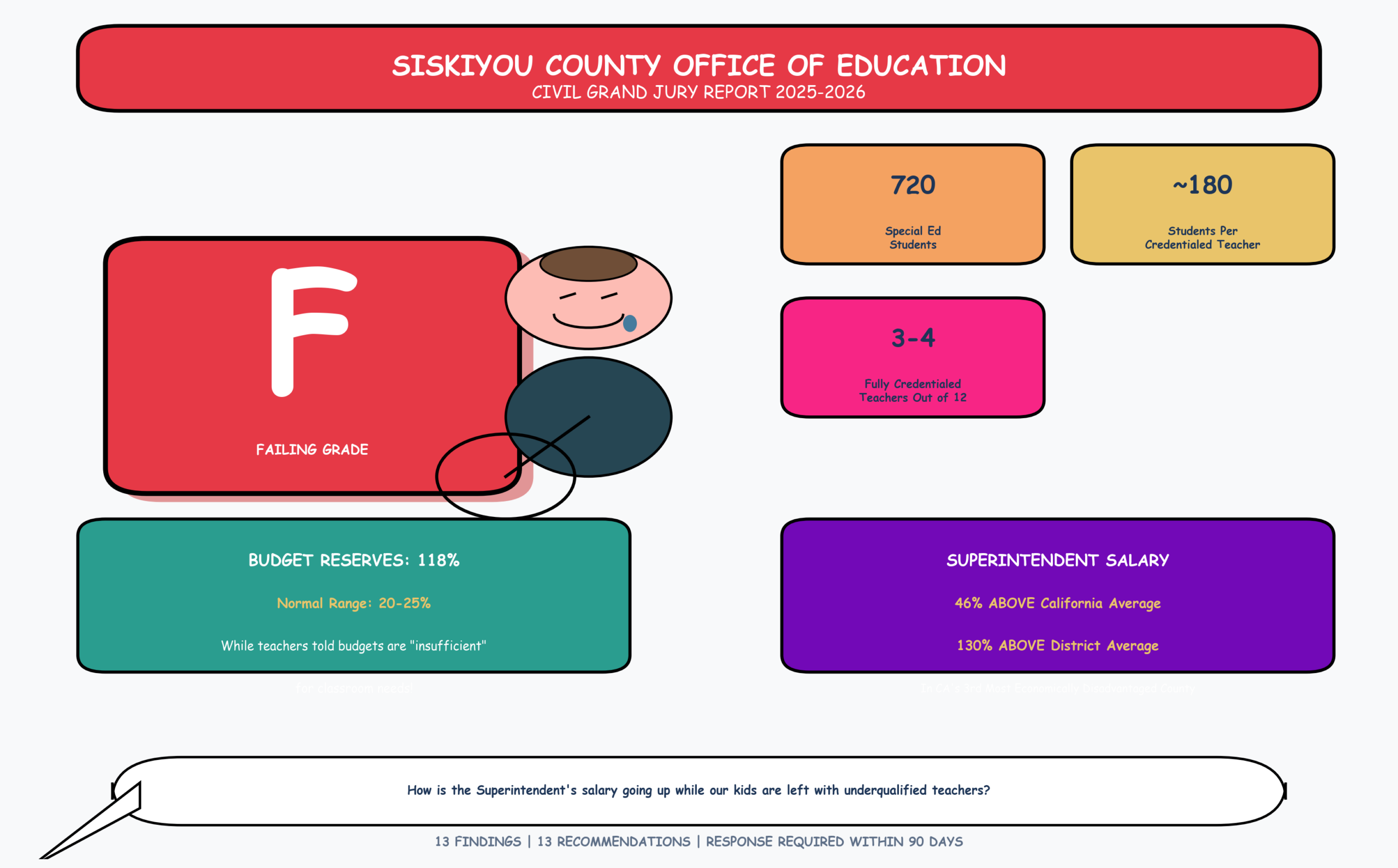
Siskiyou County Office of Education (SCOE) and Siskiyou County Board of Education (SCBE) deserve an “F” grade for not meeting the needs of its students with learning, physical and behavioral disabilities.
The Siskiyou County Civil Grand Jury (Civil Grand Jury) investigated the Siskiyou County Office of Education (SCOE) and the Siskiyou County Board of Education (SCBE) in response to multiple complaints from employees, educators and members of the public. The investigation examined special education staffing and compliance, workplace conditions, board governance and hiring and fiscal practices. The Civil Grand Jury found evidence of systemic deficiencies in the management of special education programs, a pattern of workplace conditions inconsistent with applicable law, inadequate oversight by both Siskiyou County Office of Education (SCOE) and Siskiyou County Board of Education (SCBE) and hiring and compensation practices that raise concerns about equity and legal compliance.
The Civil Grand Jury recommends corrective action by SCOE administration and the SCBE to restore legal compliance, protect student welfare and maintain public confidence in Siskiyou County education services.
This Civil Grand Jury report intends to hold SCOE and SCBE accountable for providing a safe and effective education for all of students in Siskiyou County.
Background
The Siskiyou County Board of Education (SCBE) is the governing board for the Siskiyou County Office of Education (SCOE). The Siskiyou County Board of Education provides financial oversight, policy adoption, and specialized services for the 24 local school districts and 32 schools in Siskiyou County. The Siskiyou County Office of Education (SCOE) leases out rooms for special education classes. These classes operate center-based programs for children with moderate to severe or multiple disabilities, focusing on functional life skills sensory needs and specific medical or behavioral support.
The Siskiyou County public education system currently has more than 5400 students and approximately 720 of those students receive special education services, from SCOE. Federal law dictates all public-school districts must provide students with free and appropriate public education in the least restrictive environment. Each student qualified for special education services must have an Individual Education Plan (IEP) established to meet their educational learning needs. The IEP must be developed in collaboration with parents, school SCOE administrators, teachers, educational specialists, Psychologists, and students where appropriate, to comply with state and federal regulations under the Individuals with Disabilities Education Act (IDEA). The Grand Jury found the following during the course of its investigation:
- IEPs are not being completed in a timely manner.
- A professional Psychologist does not show up at the writing of the IEPs most of the time.
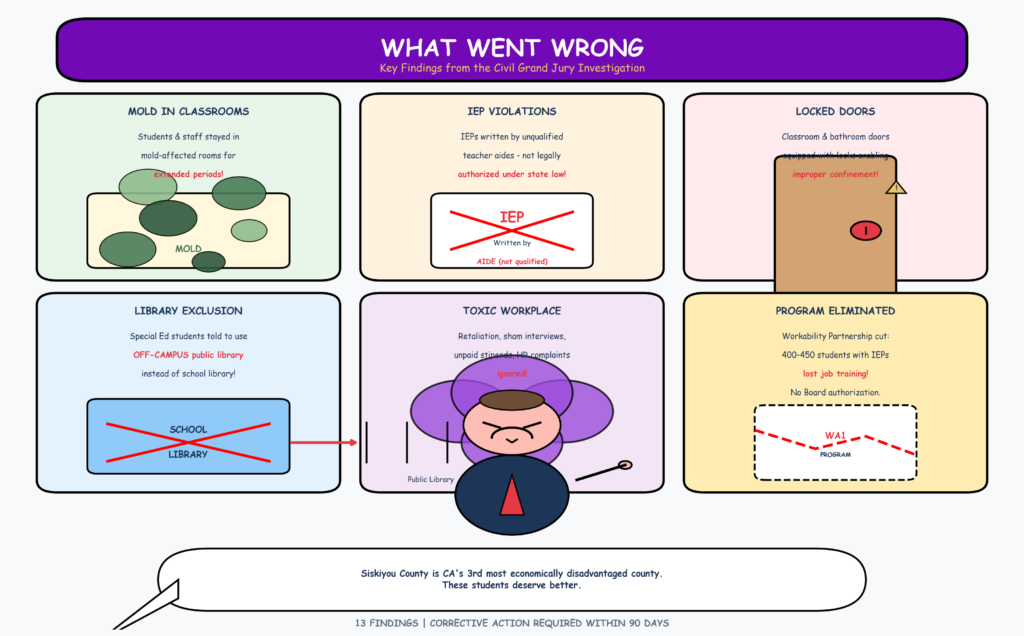
- IEPs are often written by Teachers Aides which is in violation of students’ legal rights per state law.
- The Superintendent, an elected official, fired or pushed out most of the qualified teachers that were previously involved in drafting the IEPs.
- There are non-certified Teachers Aides teaching classes where certified/qualified teachers were removed to fill positions as Administrators, thereby reducing available qualified teachers without similarly qualified replacements.
- While mold was seen during site visits in the most vulnerable students’ classrooms, Senior Administration has invested substantial funds to create a rather luxurious Administration Lounge.
- Teachers as well as Teacher Aides are teaching multiple classes simultaneously, leaving Teachers’ Aides often teaching classes as if they were the Teachers.
- There appears to be a lack of credential teachers and a wide disparity between administrators’ salaries and teacher salaries. The current County Superintendent’s salary is 46% higher than the average salary for a County Superintendent position in California for 2024 and 130% higher than the average County Superintendent salary in a California wide average school district. Siskiyou County is the 3rd most economically disadvantaged county in the State of California.
Methodology
The Civil Grand Jury reviewed SCBE and SCOE budget documents, SCBE Board of Trustee meeting minutes and agendas, Board policies, hiring records and job descriptions, salary schedules, credential records, Individualized Education Program (IEP) documentation, school facility records, Fiscal Crisis Management Assistance Team (FCMAT) reports, state Education Code provisions, and applicable both to SCBE and SCOE policies. The Grand Jury also reviewed SCBE and SCOE records pursuant to its authority to do so under California Penal Code Section 921. The Grand Jury also reviewed the Hatch Act (5 U.S.C. § 7321 et seq.), California Government Code Section 12940, California Education Code Section 49005 et seq., and applicable Education Code provisions governing IEPs and teacher credentialing California Education Code Part 30 (§§ 56000–56865) and Teacher Credentialing.
Formal public records requests were submitted to SCOE in January 2026 and March 2026, seeking records for the 2024–2025 and 2025–2026 school years, including teacher credentials, salary records, IEP minutes, program funding lists, evidence of stipend payments, school nurse qualifications and job vacancies lists.
The Grand Jury conducted approximately twenty-six (26) formal witness, interviews with individuals having direct knowledge of SCOE and SCBE operations, including current and former SCOE employees, a parent advocate with extensive experience navigating the SCOE’s special education system, school district administrators, and a charter school executive director. Site visits were conducted at Special Day Class facilities, Gold Street, Child’s Way, Jakson, Evergreen.
Discussion
Governance and Board Oversight (See Appendix B)
The Siskiyou County Board of Education (SCBE) and its Seven members (right now there are Two vacant seats) they are elected by the public to a four-year term. The board is composed of members elected from Seven distinct geographical trustee areas across the county, meaning voters only elect the trustee representing the specific area in which they reside. This Board, (SCBE) is the governing board and decision makers for the Siskiyou County Office of Education (SCOE). The SCBE is vested by law with the authority to adopt policies and procedures governing the SCOE, approve the annual SCOE budget, set and evaluate the County Superintendent’s performance and compensation, review and approve the annual SCOE audit, and maintain fiscal oversight and control over the financial conditions across Siskiyou County’s 24 school districts. The Civil Grand Jury’s review of the SCBE Board practices indicates that the Board of Trustees has not consistently fulfilled these responsibilities. Specifically, the Civil Grand Jury found that the SCBE Board process for evaluating and awarding compensation increases to the County Superintendent lacking documented criteria and performance review procedures. Public records and interviews confirmed that a recent salary increase of the Superintendent’s salary was approved in 2026 without a documented performance evaluation. The President of the SCBE Board of Trustees testified to the SCCGJ that they approved the County Superintendent’s pay increase because “He was there and his heart was beating, so he got a raise.”
Special Education, Staffing and Credentials
California Education Code (56000-56865) and the Federal Individuals with Disabilities Education Act (IDEA) require that special education instruction be provided by credentialed teachers. The Grand Jury’s review of records from SCOE and teacher credential documentation found that Special Day Classes were staffed, in some instances, by individuals holding emergency or non-teaching credentials rather than full Education Specialist Instruction Credential. To teach special education in California, one must earn an Education Specialist Instruction Credential. This is a two-tiered credentialing system (a Preliminary credential followed by a Clear credential) authorizes an individual to teach students with specific disabilities and support needs in a variety of educational settings.
Interview testimony from multiple sources established that of approximately 12 SCOE special education teachers, only three to four are fully credentialed for their current assignments (with 720 Special Education students, this comes to an average of 180 students for each credentialed teacher); the remainder hold provisional credentials or are operating under emergency or intern arrangements. The Grand Jury found evidence that this reliance on provisionally credentialed staff was not isolated to special education and reflected a systemic system wide pattern rather than a temporary gap.
The Civil Grand Jury also found that SCOE’s appointment of the Special Education Local Plan Area (SELPA) Director raises governance concerns. Multiple independent witnesses, including education professionals with direct knowledge of the SCOE’s hiring process, reported that a hiring committee recommended a more qualified candidate for the SELPA Director position, and that the appointment was made contrary to that recommendation. The SELPA Director is the SCOE official, responsible for ensuring IDEA compliance across all 24 school districts served by SCOE. Multiple credible sources identified the appointed IDEA Director as lacking adequate depth of special education program, legal, and procedural expertise for this role.
Additionally, IDEA and the California Education Code (56000 et seq.) require that Individualized Education Programs (IEPs) must be developed by a qualified team that includes a school psychologist. The Grand Jury found evidence that school psychologists did not consistently participate in IEP development meetings as required, and that IEPs were, in some instances, written by unqualified non credentialed teacher aides not authorized under State or federal law. The Grand Jury also found evidence that IEPs were not completed or implemented within legally required timelines, and that documentation practices in some cases appeared designed to avoid regulatory scrutiny rather than to accurately reflect service delivery.
Special Education — Facilities and Student Access
The Grand Jury conducted site visits to Special Day Class (SDC) facilities for students with special needs. They received corroborated accounts regarding physical conditions. During one Civil Grand Jury site visit to an elementary school, mold was found to be present in multiple Special Day Classrooms, including identified sites where students and staff remained in the affected spaces for extended periods of time before relocation. Air quality testing (Pro-Lab & Shasta Premier Inspection Group) was conducted at one site, room 6, SDC Gold Street School, 50 items inspected with 3 deficiencies, but independent environmental specialists were not engaged in a timely manner; remediation at that site has reportedly been deferred to summer. If remediation is not completed before the start of the 2026/27 school year, these findings warrants expedited action.
Witness interviews revealed SDC students elected to use public library resources at an off-campus public library when the students were not welcomed to the school library by the school librarian.
During the Civil Grand Jury’s site visit, it was discovered that SDC classroom and bathroom doors were found to have locking mechanisms consistent with improper confinement use, raising serious safety and legal concerns under California Education Code Section 49005 et seq. These conditions are inconsistent with the requirements of a safe and appropriate educational environment under State and federal law and fire codes.
Workforce Environment
The Civil Grand Jury received multiple corroborated accounts of a toxic and hostile work environment within the SCOE administration. Reported conditions included:
- Failure of the SCOE Human Resources department to investigate employee complaints.
- Possible retaliatory treatment of employees who raised concerns.
- Inappropriate teacher classroom assignments, adding more students to the rooms, used as a form of retaliation.
- Non-payment or diversion of classroom supply stipends for which credentialed teachers were entitled to California Code of Education Section 49011.
- The use of pretextual or sham interview processes in which candidates were invited to interview for positions that were not genuinely open to them.
The Civil Grand Jury also found evidence that individuals were elevated to administrative positions without holding the credentials required for those positions, and that this practice had the effect of reclassifying employees out of bargaining unit membership, thereby undermining collective bargaining rights and benefits. Human Resources personnel records were found to be incomplete in at least one documented case, with annual performance reviews and injury documentation absent from an employee’s file, as reported in interviews with employees.
Political Activity
California and federal law restrict political activity in the public workplace by public employees during working hours and on public premises. The Civil Grand Jury found evidence that political campaign activity occurred in a SCOE employment setting, inconsistent with applicable rules governing political and lobbying activity by SCOE officers and employees. (California Government Code Section 8314)
Fiscal Practices
The Civil Grand Jury’s review of funding allocation records identified concerns regarding the equitable distribution of discretionary funds among school districts served by SCOE. Specific concerns regarding stipend payment records were also identified, including the absence of documentation confirming that classroom supply stipends were distributed to credentialed teachers as required pursuant to California Code of Education Code-EDC Section 49011
Budget accounts consistent with financial records indicating that SCOE maintains budget reserves of approximately 118% according to interviews, significantly above the 20–25% customary range for other similar school districts in California, while staff are routinely advised that budgets are insufficient for classroom needs. These findings, taken together, raise questions about fiscal transparency and the equitable allocation of SCOE education funding resources. This finding is based on corroborated interviews from multiple sources and review of SCOE budget documentation.
Student Transition Programs
The Civil Grand Jury found that SCOE voluntarily relinquished its Workability Partnership Program a fully federally funded vocational educational training program that had served approximately 400 to 450 students with IEPs, providing work experience, employer partnerships, and employment-readiness credentials to those students. The Workability Partnership Program (WA1) is a federally supported entitlement program for students with disabilities transitioning to employment. Multiple independent witnesses confirmed its elimination from the 24 school districts in Siskiyou County and attributed the decision to administrative convenience rather than budget necessity. The Grand Jury found no evidence of documented SCBE Board of Trustee authorization for the elimination of the WA1 Program or student-impact analysis prior to such a decision. Reinstatement of the WA1 Program is unlikely in the near term due to statewide funding framework and State wait list constraints. Meaning, when the school is out of the grant program, some other school has that grant.
Findings and Recommendations
Finding 1. The Siskiyou County Board of Education did not conduct documented performance evaluations prior to approving compensation increases for the County Superintendent of Schools, contrary to its oversight responsibilities under the California Constitution Article IX, Section 3.1(b) and California Education Code section 1209.
Recommendation 1. The Siskiyou County Board of Education should adopt and implement a formal written policy for the evaluation of the County Superintendent’s performance, to be completed prior to any consideration of compensation adjustments. The policy should include measurable criteria and a documented review process.
Finding 2. Siskiyou County Office of Education (SCOE) administration staffed Special Day Classes with non-credential or under-credentialed personnel in violation of California Education Code, Title 5, Section 3053 requirements for special education teacher accreditation. After reviewing all the documents and interviews, the Civil Grand Jury uncovered during its investigation that approximately 12 SCOE special education teachers, only three to four, are fully credentialed for their current assignments. This comes to an average of 180 students for each credentialed teacher.
Recommendation 2. Siskiyou County Office of Education should audit the teaching credentials of all current Special Day Class instructional staff using the California Commission on Teacher Credentialing (CTC) requirements for the credentialing of special education teachers and within 90 days of this report’s publication, develop and implement a written plan to bring all SDC staffing into compliance with California Education Code credential requirements.
Finding 3. Siskiyou County Office of Education failed to ensure that Individualized Education Programs (IEPs) were completed and implemented within timelines required by the Individuals with Disabilities Education Act (IDEA) and the California Education Code 56000.
Recommendation 3. Within 90 days, SCOE should implement an IEP compliance tracking system to ensure that all IEPs are completed and implemented within legally required timelines and that required participants, including school psychologists, are present at all IEP meetings.
Finding 4. School psychologists did not consistently attend IEP meetings as required by IDEA and California Education Code 34 CFR Section 300.321 and IEPs were written in some instances by staff not authorized to do so under law.
Recommendation 4. Siskiyou County Office of Education should implement a written IEP compliance tracking system to ensure that all IEPs are completed and implemented within legally required timelines and that required participants, including school psychologists, are present at all IEP meetings.
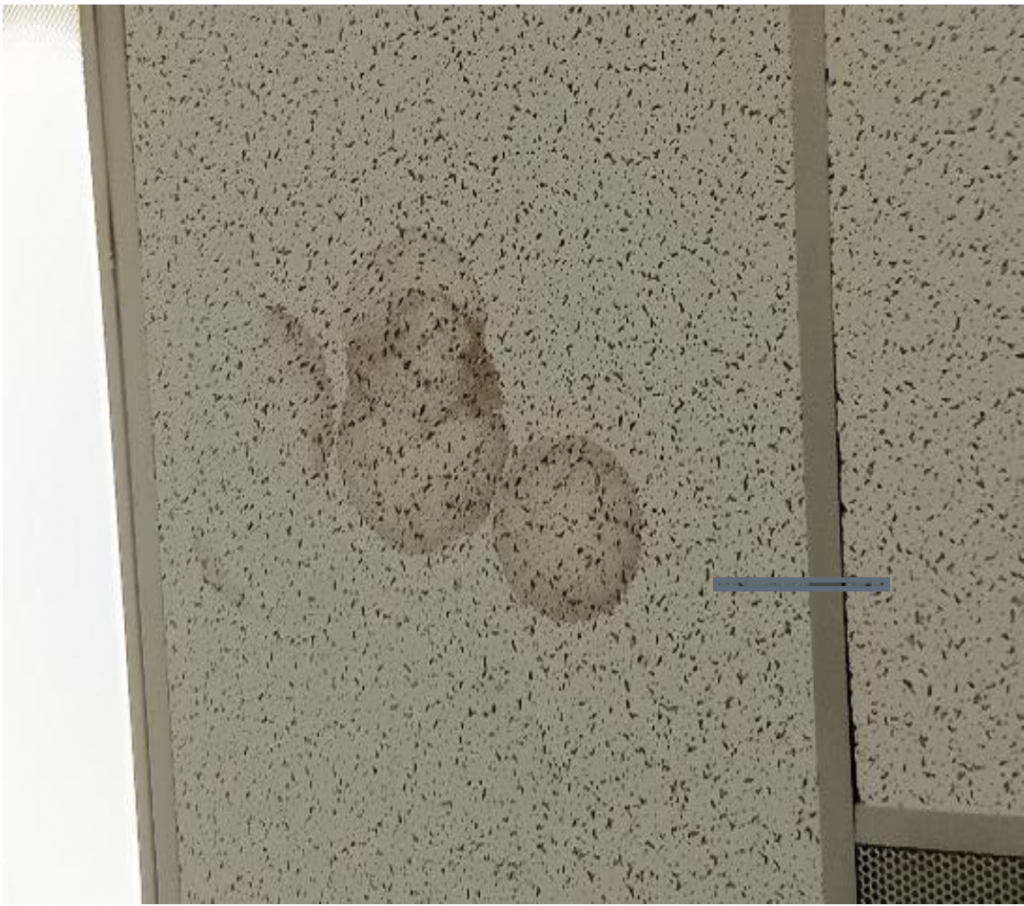
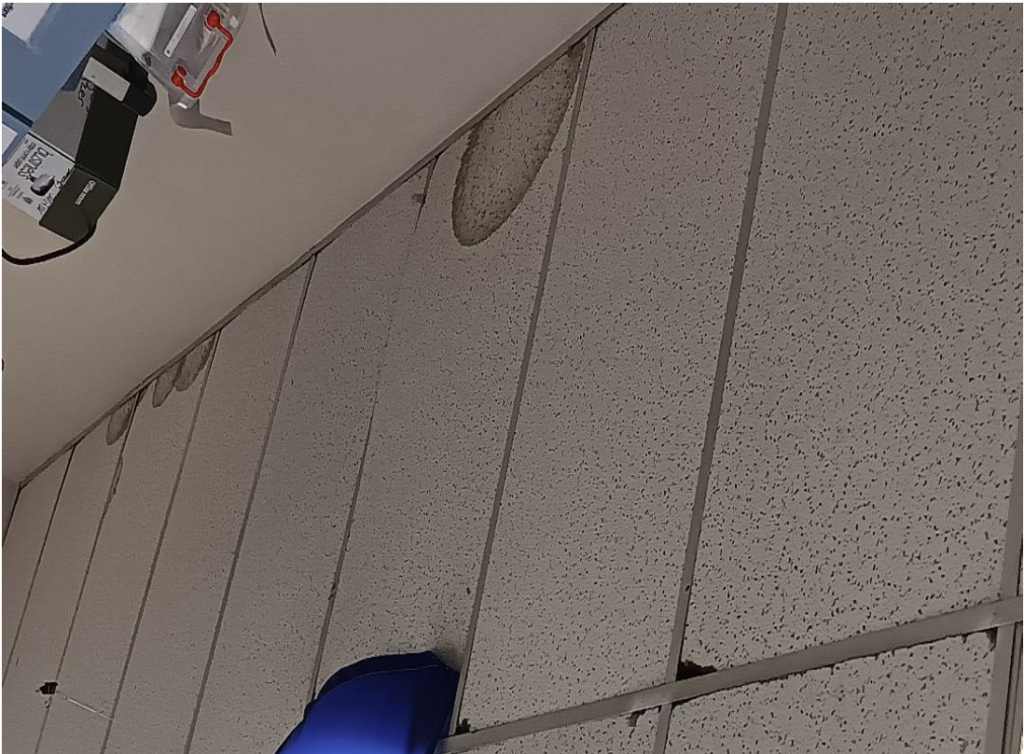
Finding 5. Physical conditions in Special Day Class facilities, including the presence of mold at multiple identified sites, pose health and safety risks to students with disabilities and school staff. Students and staff remained in mold-affected classrooms for extended periods of time before relocation.
Recommendation 5. Siskiyou County Office of Education should hire mold inspection professionals to conduct a facility inspection of all Special Day Class classrooms within 60 days of this report’s publication, remediate all identified mold and safety hazards, and provide written confirmation of completed remediation to the Siskiyou County Board of Education prior to the start of the next 2026/27 school year. Remediation at one site has been deferred; the Grand Jury urges confirmation that remediation is completed before the start of the next school year.
Finding 6. Special Day Class students were not provided with equitable access to school campus library resources, instead, requiring them to access off-campus public library facilities.
Recommendation 6. Within 90 days, Siskiyou County Office of Education should adopt a written policy ensuring that Special Day Class students have equitable access to campus school library facilities, consistent with the requirements of IDEA and the California Education Code.
Finding 7. Siskiyou County Office of Education’s Human Resources department did not consistently investigate or act upon employee complaints of workplace hostility and retaliation, creating conditions possibly creating toxic and hostile working conditions.
Recommendation 7. Within 90 days, Siskiyou County Office of Education should review and revise Human Resources harassment complaint handling procedures to ensure that all employee complaints of workplace hostility or retaliation are investigated and documented, consistent with California laws.
Finding 8. Siskiyou County Office of Education did not maintain adequate documentation confirming that classroom supply stipends were distributed to credentialed teachers as required by California Code, Education Code-EDC Section 49011.
Recommendation 8. Within 90 days, Siskiyou County Office of Education should audit classroom supply stipend payment records for the 2024–2025 and 2025–2026 school years and provide documentation to the Siskiyou County Board of Education confirming that stipends were distributed as required or, where not distributed, account for the disposition of those funds.
Finding 9. Siskiyou County Office of Education employees were placed in administrative positions without holding required administrative credentials, a practice that had the effect of impacting their prior bargaining unit membership and undermined collective bargaining rights.
Recommendation 9. Within 90 days, Siskiyou County Office of Education should audit the credentials of all individuals currently serving in administrative roles and ensure that all such positions are filled only by individuals holding the required credentials under California Education Code.
Finding 10. Siskiyou County Office of Education voluntarily relinquished its Workability Partnership Program (WA1) slot, a fully federally funded vocational training program serving approximately 400 to 450 students with IEPs, without documented SCBE Board of Trustee authorization or student-impact analysis, thereby eliminating a federally supported transition-to-work program for students with disabilities which is inconsistent with 34 Code of Federal Regulations Section 300.43.
Recommendation 10. Siskiyou County Office of Education should provide the Siskiyou County Board of Education with a written accounting of the decision to relinquish the Workability Partnership (WA1) program slot, including the process used, any Board of Trustee authorization obtained, and the impact on affected students. The SCBE Board should direct SCOE to take all available steps to restore the program or identify equivalent federally funded transition services, and to report back every 180 days until complete.
Finding 11. School District teaching staff are routinely advised that budgets are insufficient for classroom needs.
Recommendation 11. Within 90 days the Siskiyou County Board of Education Board of Trustees should commission an independent review of SCOE’s budget reserve levels and allocation practices.
Finding 12. The Superintendent at SCOE appointed a SELPA Director who was identified by multiple credible sources as lacking adequate depth of special education expertise and who was selected contrary to the recommendation of the hiring committee, raising concerns about governance and compliance capacity for the special education programs within the Siskiyou County public education system.
Recommendation 12. Within 90 days the Siskiyou County Board of Education should review the SELPA Director hiring process, including the interview committee’s recommendation and the basis for the appointment decision, and should ensure that the SELPA Director position is held by an individual with demonstrated expertise in special education law, program compliance, and IDEA implementation
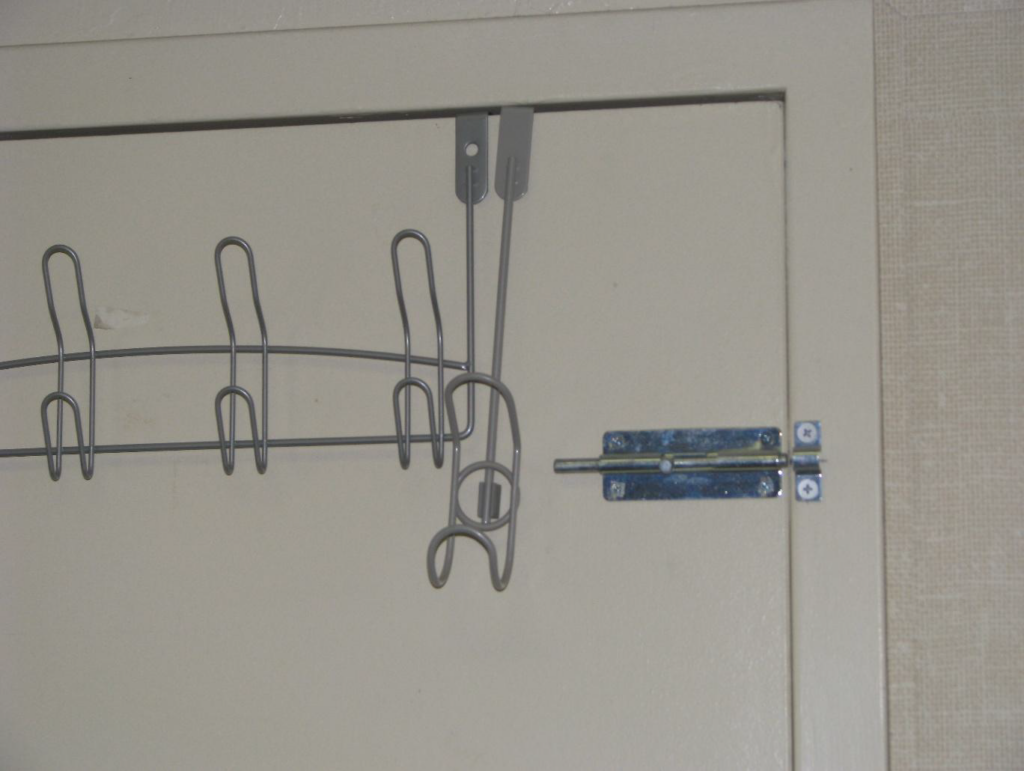
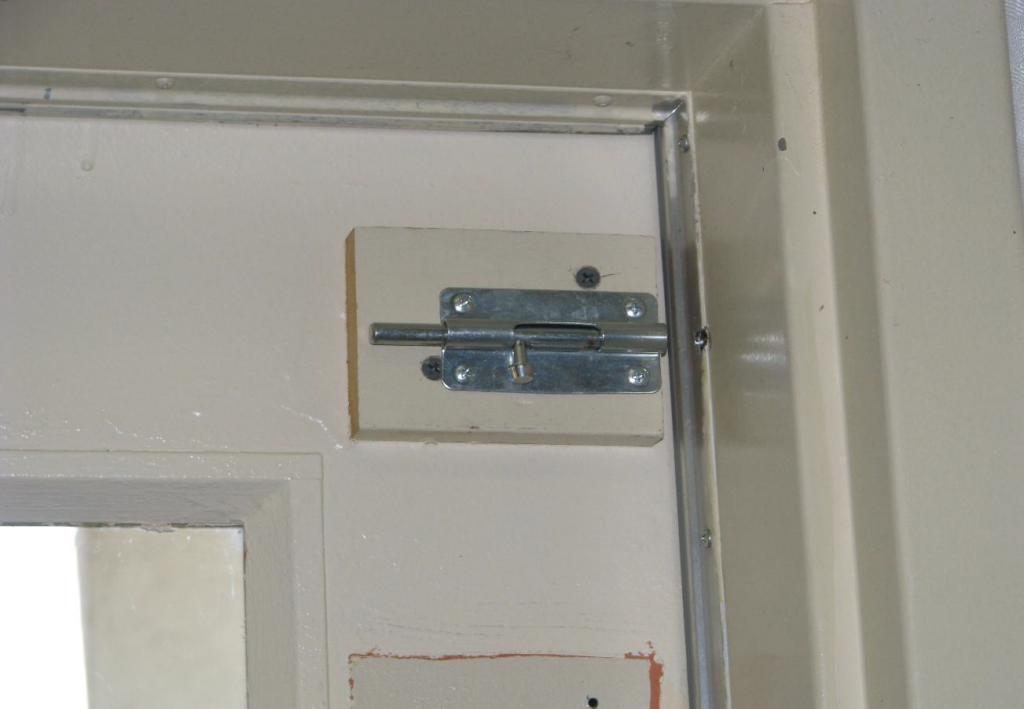
Finding 13. Special Day Classes (SDC) classrooms are equipped with locking devices on classroom and bathroom doors that enable the confinement of students with disabilities in bathroom spaces, a practice inconsistent with California Education Code Section 49005 et seq. and IDEA provisions governing restraint as well as fire codes.
Recommendation 13. Siskiyou County Office of Education should immediately conduct a physical inspection of all SDC classroom and bathroom door hardware, remove any locking devices capable of confining students, and within 30 days adopt and distribute a written policy on restraint consistent with California Education Code Section 49005 et seq.
Responses
Required Responses (California Penal Code Section 933.05):
The Siskiyou County Board of Education and the Siskiyou County Office of Education are required to respond to all Findings and Recommendations within 90 days of receipt of this report.
The Siskiyou County Superintendent is required to respond to all Findings and Recommendations within 90 days of receipt of this report.
Invited Responses:
- The Siskiyou County Office of Education Director of Human Resources is invited to respond Finding 7 and Recommendation 7.
- The SELPA Executive Director is invited to respond to Findings F2, F3, F4, F6, F10, F13 and Recommendations R2, R3, R4, R6, R10, R13.
- Maintenance and Operation Director is invited to respond to Finding 5 and Recommendation 5.
Appendix
A. Applicable Law and Authority
California Education Code — Governs teacher credentialing requirements, IEP timelines and composition, board of education duties, special education program standards, and restraint and seclusion practices (Section 49005 et seq.).
Individuals with Disabilities Education Act (IDEA), 20 U.S.C. § 1400 et seq. Federal law requiring that students with disabilities receive a free appropriate public education; mandates IEP team composition, timelines, implementation, and transition services including vocational programs.
California Penal Code Section 921 Authorizes the Civil Grand Jury to examine all county officers and to compel the production of public records.
California Penal Code Section 924.1 Prohibits disclosure of grand jury witness identities; governs confidentiality of proceedings.
California Penal Code Section 933.05 Establishes response requirements for governing boards and elected officials named in Civil Grand Jury reports.
Hatch Act, 5 U.S.C. § 7321 et seq. Restricts partisan political activity by certain state and local employees whose positions are connected to federally funded programs.
Part 30 of the California Education Code (Title 2, Division 4) governs Special Education Programs in California, covering §§ 56000–56865. These sections set the legal framework for how special education services are provided, administered, and funded, and they also establish qualification standards for special education teachers and related service personnel.
B. Board of Education Statutory Duties
Under California law, the Siskiyou County Board of Education is charged with the following responsibilities with respect to SCOE:
- Adopt policies and regulations governing the County Office.
- Approve the annual budget of the County Office.
- Set and evaluate the County Superintendent’s salary.
- Receive the annual audit.
- Maintain awareness of financial conditions and operations of school districts in the county.
- Approve the purchase or lease of property for County Office programs.
- Serve as an appeal board for expulsions and inter-district attendance transfers.
- Serve as the Siskiyou County Committee on School District Organization.
Siskiyou County Civil Grand Jury | 411 Fourth Street, Yreka, CA 96097 | 2025–2026 Term